|
|
|
|
 |
Home > New energy > Fuel Cell |
|
|
|
|
|
|
| |
 Fuel Cell? Fuel Cell?
|
|
|
| |
Technology to convert the fuel’s chemical energy into electronic energy with many advantages such as the high conversion efficiency, less air pollution and reduced transmission loss.
Generation Principles
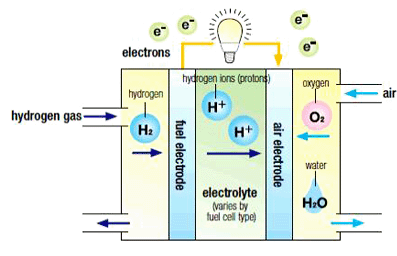
In water electrolysis, oxygen and hydrogen are generated from electrodes. In case of fuel cell, use the reverse reaction of this electrolysis to generate electricity out of oxygen and hydrogen. Hot water produced during the process can be used for heating.
|
 |
|
|
Features of Fuel Cells |
|
|
| |
 |
40~60% of generation efficiency and in the case of cogeneration, over 80% is available |
|
Available to use various fuels e.g. natural gas, methanol, and coal gas |
|
Reduction of air pollution: do not emit NOx, SOx and dust, and reduce the amount of CO₂emission by 20~40% against that of coal thermal power generation. |
|
Since no rotating units, do not make noise, and no need to use a large
amount of cooling water like previous thermal power generation |
|
 |
Available to install near populated areas, and less electricity/facility loss in transmission and distribution
Rapid response depending on the load changes, and available for various purposes such as local installation type, distribution type and central type.
|
|
| |
|
|
Types of Fuel Cells |
|
|
| |
|
|
|
|
|
|
|
|
|
| Type |
|
Molten Carbonate Fuel Cell Type
(MCFC)
|
|
Solid Oxide
(SOFC)
|
|
Polyelectrolyte
(PEMFC) |
|
Direct Methanol
(DMFC) |
|
|
|
|
|
|
|
|
|
| Electrolyte |
|
Carbonate

|
|
Zirconia

|
|
Zirconia
 |
|
Ion Exchange
Membrane
(Nafion)
|
|
|
|
|
|
|
|
|
|
| Working Temp.(?? |
|
600~1000 |
|
Around 650 |
|
Room Temp.~80 |
|
Room Temp.~100 |
|
|
|
|
|
|
|
|
|
| Efficiency(%) |
|
45~60 |
|
50~60 |
|
40~0 |
|
0~30 |
|
|
|
|
|
|
|
|
|
| Purpose |
|
Mid, Large Capa
Generation |
|
Small, Mid, Large Capa
Generation
|
|
Fixed, Mobile |
|
Small, Mobile |
|
|
|
|
|
|
|
|
|
|
|
|
|
|
|
|
|
|
|
| |
|
|
|
|
|